
A practical room-by-room guide to sizing Colorado mountain photography wall art — with real measurements, simple formulas, and one technique that eliminates almost all the guesswork.

A blank wall is surprisingly hard to read. You know roughly where the print should go, you know the general vibe you're after, and you might even have a specific image in mind. But knowing what a number in inches will actually look like on a wall is a different problem entirely.
The problem isn't indecision. It's that print sizes are abstract until they're on the wall. A 24×36 sounds substantial. Sometimes it is. Sometimes it disappears entirely against a ten-foot wall. A 40×60 sounds imposing until you're standing in a great room and realize the scale of the space swallows it whole.
Colorado mountain photography makes this decision harder than most. These are huge landscapes featuring alpine lakes, glacial valleys, and snowcapped peaks that stretch unbroken for miles. Prints with these subjects deserve room to breathe. Undersizing them doesn't just look off; it actually changes what the image communicates. The sense of scale, the feeling of being small in front of something enormous — that lives or dies in the print dimensions.
This guide cuts through the guesswork. By the end, you'll know exactly what size to order for your specific wall, your specific room, and your specific image — and why the most common mistake is always going too small.
Here's the thing: sizing Colorado mountain photography wall art isn't guesswork. There are real formulas, room-by-room rules, and one dead-simple technique that eliminates almost all the uncertainty before you spend a dollar. This guide walks through all of it.
Why Size Is the Decision That Matters Most
Print medium matters. Subject matters. But size is the decision that determines if your Colorado mountain photography wall art feels intentional and powerful in any room.
Art that's too small floats. It looks like a placeholder — the thing you hung while waiting to find something better. It makes the wall feel larger and emptier than it actually is, which is almost never the effect you want.
Art that's too large can work, actually. Rooms usually absorb a slightly oversized piece better than they absorb an undersized one, because large art reads as deliberate. The wall feels claimed.
The sweet spot is proportional art — and that's a function of the room, the wall, and whatever furniture anchors the space below or beside the piece.
Two rules handle most situations.
The Two Sizing Rules
Rule 01
The 60–75% Rule
For art hanging above furniture (a sofa, a bed, a console table, a dining table) the width of the art should be 60–75% of the width of the furniture beneath it.
This gives you a working range. The lower end (60%) feels balanced and airy. The upper end (75%) feels full and intentional. Most designers land somewhere in the middle.
Practical examples:
- 84-inch sofa → art 50–63 inches wide
- 76-inch king bed → art 46–57 inches wide
- 60-inch queen bed → art 36–45 inches wide
- 72-inch dining table → art 43–54 inches wide
These aren't rigid rules, but rather starting points. A particularly dramatic Colorado mountain photograph can push toward the upper end. A quieter, more atmospheric image might sit better on the lower end.
Rule 02
Half the Viewing Distance
For freestanding statement pieces with no furniture beneath them (like a large wall, a foyer, an open living area) think about your typical viewing distance.
Measure (or estimate) how far away you'll normally see the piece from. Divide by two. That's a good target width for strong visual impact at that distance.
- Viewing from 12 feet away → 72 inches wide
- Viewing from 10 feet away → 60 inches wide
- Viewing from 8 feet away → 48 inches wide
- Viewing from 6 feet away → 36 inches wide
The math behind this rule is intuitive: an image needs enough physical presence to read properly at a given distance. Detail that's compelling at three feet is invisible at twelve.
Room by Room
The Living Room
This is where most Colorado mountain photography wall art ends up. It's also where most sizing mistakes happen.
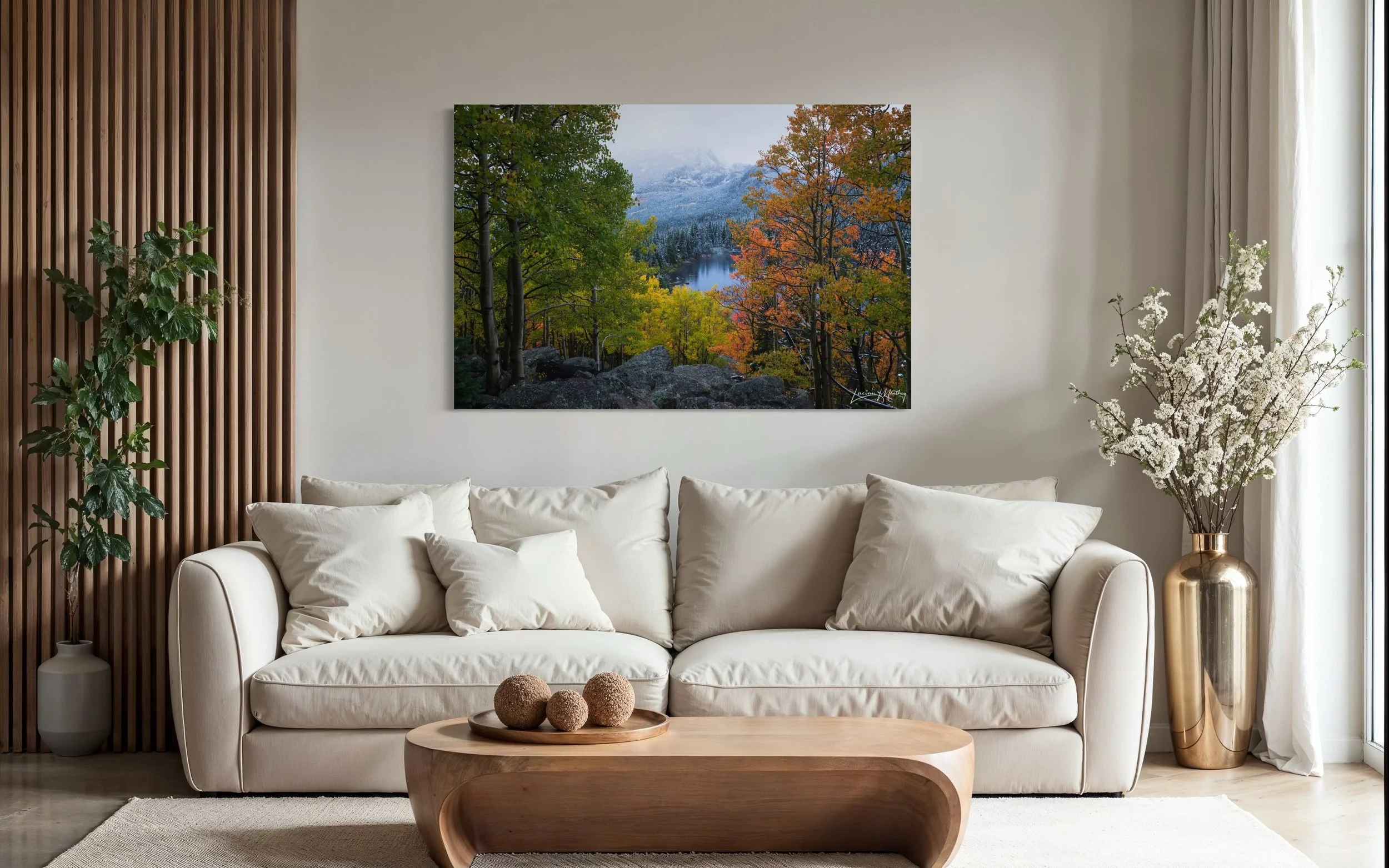
Above the sofa is the most common placement, and the most commonly botched. The 60–75% rule applies strictly here. For a standard 84-inch sofa, you want something in the 50–63-inch range. In print sizes, that translates to a 40×60 as your baseline.
The gap between the top of the sofa and the bottom of the frame matters too. Six to eight inches is the standard. Too close and the sofa and art feel merged. Too far and they feel disconnected.
On a primary wall with no furniture beneath it: This is your best opportunity for something genuinely large. A 10-foot ceiling can handle a 60×90 without issue. Even 8-foot ceilings absorb large-format landscape prints well if the print is horizontal — the low horizontal orientation visually widens the room rather than cutting through it vertically.
A panoramic format (20×60, 24×72, or wider) works exceptionally well on a long living room wall, particularly for mountain range images where the horizontal expanse of the Rockies is part of what makes the image worth having.
A mistake to avoid: breaking up one large-format piece into multiple smaller prints to cover the same wall. It almost never reads as well as a single strong image. Colorado mountain photography wall art earns its power from scale. Let it have scale.
Shop Colorado mountain photography prints
Gallery Metal, TruLife Acrylic & Giclée — free shipping on every order.
The Bedroom
The primary placement is above the headboard, and the framing question is different here as you're working with the bed, not the wall.
For a king bed (approximately 76 inches wide), artwork in the 46–57-inch range looks intentionally sized. Something narrower feels undersized relative to the bed. Something much wider starts to feel like it belongs in a different room.
For a queen (approximately 60 inches wide): 36–45 inches wide.
Height matters particularly in the bedroom. The bottom of the frame should sit 6–10 inches above the headboard. If the headboard is tall (36 inches or more), you might push that gap to 10–12 inches to give the piece room to breathe.
Subject choice for bedrooms: lighter, calmer Colorado mountain scenes tend to work better above a bed than highly dramatic images. A soft alpine sunrise, a fog-laden valley, an intimate winter scene — these have a quieting quality that suits a bedroom. A print like Majesty over the Sneffels Range — a rainbow piercing a stormy sky above peaks glowing gold in the last light of evening — is exactly the kind of image that anchors a living room wall. In a bedroom, it might make sleeping harder.
The Dining Room
The dining room is often underused as a gallery space, but it can handle more drama than most rooms because the art competes with a full table setting rather than a quiet sofa.
For art above a buffet or sideboard, the 60–75% rule applies just as it does for sofas. The buffet is usually 48–60 inches wide, so art in the 29–45-inch range is appropriate.
For a large blank dining room wall with no furniture beneath it: this is another opportunity for a genuinely large-format piece. Dining rooms often have great natural light from windows or overhead fixtures. Colorado mountain photography looks particularly strong in these conditions — the warm tones of a sunset or alpenglow scene complement most dining room color palettes.
The Home Office
The home office is unique because the primary viewing experience is from a seated position at a desk, which changes the optimal height and size calculations.
For art on the wall directly in front of a seated desk position: the center of the piece should be at seated eye level (around 44–48 inches from the floor, rather than the standing 57-inch standard). This is particularly important for art you'll see for hours every day.
Size-wise: home offices are often smaller rooms, so a 20×30 or 24×36 is frequently the right choice. Hanging something very large in a small home office at close viewing distance can feel overwhelming. The goal is a piece that's calming and inspiring, not dominating.
Colorado mountain photography — particularly serene alpine scenes, dawn light, or moody winter imagery — is well-suited for the home office. It's the kind of imagery that rewards a second look without demanding one.
Hallways and Entryways
Hallways present a specific challenge: narrow width, longer viewing distance, and typically higher walls relative to the width of the space.
For a standard hallway (36–48 inches wide), art wider than 24 inches can feel crowded. Vertical orientation works better here than in most other rooms — a tall, narrow print has more presence in a hallway than a wide horizontal print that barely fits between the walls.
For longer hallways, a series of smaller pieces at consistent heights reads better than one large piece. Consistent spacing (4–6 inches between frames) gives it intentionality.
For entryways, the first thing you see when you walk in sets the tone for the whole space. This is worth spending on. A well-chosen Colorado mountain photograph in the right size and medium turns an entry from transitional to genuinely welcoming.
How Colorado Mountain Subjects Scale
Not all images scale the same way. This is specific to photography (versus illustrations or abstract art), and it's worth knowing before you commit to a size.
Wide panoramic mountain scenes — ridgelines, valley views, range after range receding into the distance — gain power with scale. These images are built on expanse. At 16×24, they're pleasant. At 40×60, they do what they're meant to do. If you're drawn to a sweeping mountain view, go large.
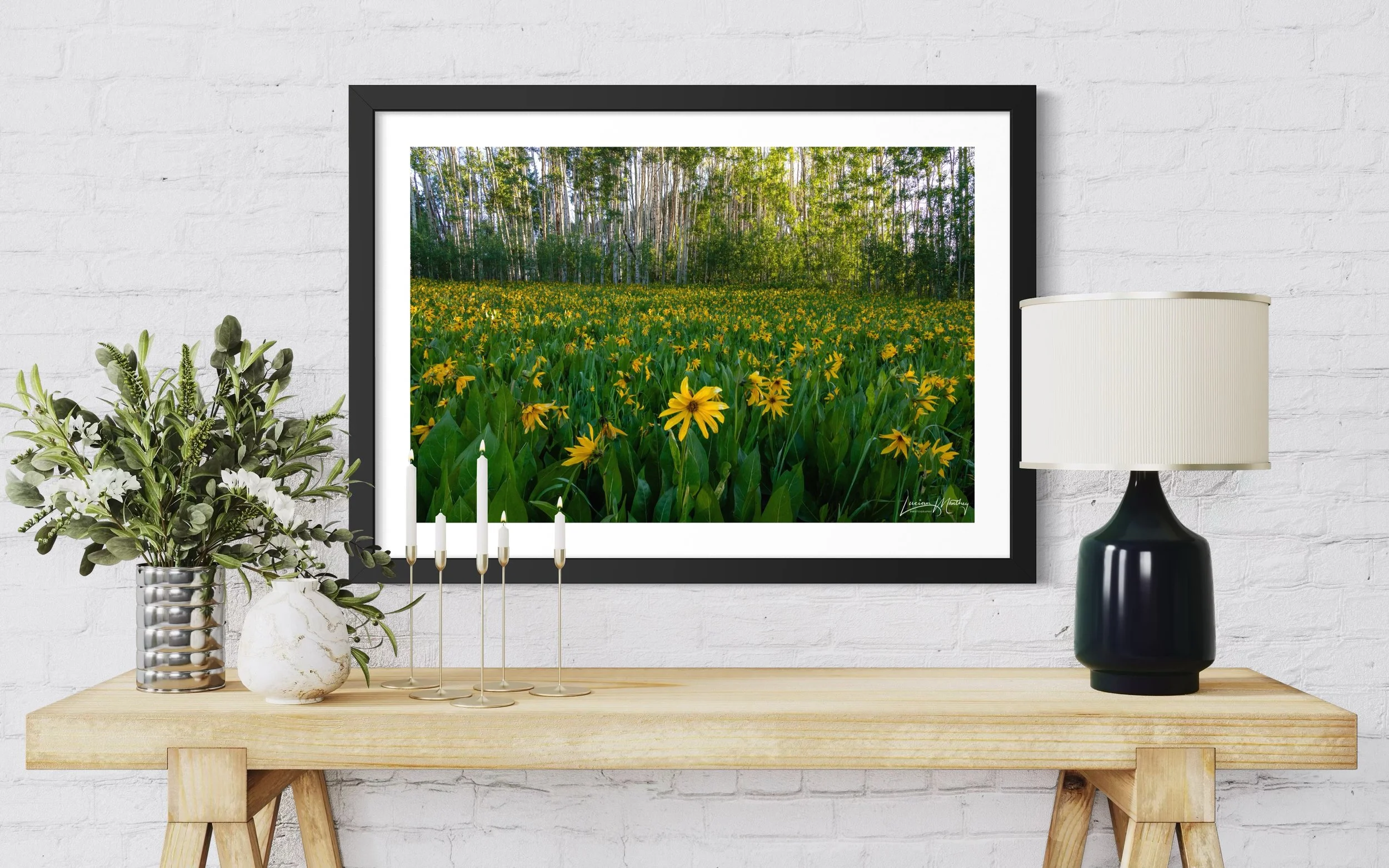
Intimate detail shots — a single peak, a group of columbine wildflowers, a waterfall deep in a forest — translate well at mid-range sizes. These images have a clear focal point that reads at 24×36. Going very large with a tight composition can feel out of place.
Atmospheric and moody scenes — pre-dawn light, fog, winter quietness — tend to work best when they're not oversized. The whole point of these images is subtlety. A 40×60 fog scene in a small room can feel like the walls are closing in. The same image at 24×36 feels meditative.
Night sky and Milky Way over mountains scale well but reward more viewing distance. These images have fine detail — star trails, nebular color, distant peaks — that requires some space to resolve properly. Hanging a large night sky print in a tight hallway where you see it from three feet away isn't ideal. Give it a wall and some distance.
My Colorado mountain photography collection at lucianmanthey.com covers all these categories — from rainbow-lit sunsets over the Sneffels Range to corridors of gold aspen in peak fall color. Browse the full gallery to find the right image for your space.
Landscape vs. Portrait Orientation
For Colorado mountain photography, landscape orientation (wider than tall) is the natural default — and there are good reasons for that beyond just how mountains look.
Landscape-format art echoes the horizontal lines already present in most rooms: sofas, beds, dining tables, console tables, rugs. Adding a horizontal print extends and reinforces those lines. The room feels settled and calm.
Portrait orientation (taller than wide) works well for specific applications, like a narrow wall between doors, a tall accent in a room with high ceilings, or a vertical subject like a waterfall or a deep canyon. For Colorado mountain ranges, though, a portrait crop often feels like you've cut the image off at both sides.
Square formats are underused and can be surprisingly effective. A square print above a console table, or as a single centered piece on a modest wall, avoids the "which way is it oriented" question entirely. Some Colorado mountain images — particularly intimate landscapes and macro scenes — feel natural in a square format.
The Painter's Tape Test
Here it is. The thing that costs nothing, takes five minutes, and eliminates almost all uncertainty.
Before you order any Colorado mountain photography wall art, mark the exact dimensions on your wall with painter's tape. Width and height. The full rectangle of the print (or the frame, if you're getting a framed piece).
Then step back. Live with it for a day. See it in morning light and evening light. See it when you walk past it and when you sit in front of it.
You'll know immediately whether the size is right. More often than not, you'll stretch the tape to make it bigger. Occasionally you'll decide to pull it in. Either way, you'll make a better decision than if you'd just ordered based on gut feel.
If you're deciding between two sizes, tape out both. Not simultaneously — do one for a day, pull it, and do the other the next day. The contrast is usually decisive.
This is so simple it almost sounds too simple. It works.
Not sure what size works for your wall?
Send me a straight-on photo of your wall and its width in inches, and I'll send back a free custom digital mockup showing different print sizes in your actual space.
Get a free wall mockup →Getting It on the Wall
You've ordered. It's arrived. Now the hanging.
Center height: 57 inches from the floor to the center of the piece is the standard, and it works because it's roughly eye level for a standing adult. Stick to this unless the piece is above furniture — in that case, use the 6–8 inch gap rule from the furniture top.
Hardware by weight:
- Under 5 lbs: adhesive hooks or strips
- 5–20 lbs: plastic drywall anchors
- 20–50 lbs: metal anchors, or better yet, studs
- Over 50 lbs (large acrylic, large framed pieces): mount into studs or use a French cleat
For large Colorado mountain photography wall art — anything 40×60 and up — mount into studs. Don't trust drywall anchors at that size and weight. A stud finder is vital and only costs $20. Use it.
Two hooks for wide pieces. For anything wider than 30 inches, two hooks spaced at one-third and two-thirds of the piece's width keeps it level and prevents the gradual rotation that eventually makes you slightly crazy.
Level matters more than you think. An off-level print pulls at you subconsciously. Use a level. Every time. Even if you "have a good eye for level" — use the level.
If you're unsure which size works for your specific wall before ordering, reach out with your room dimensions and the wall you're working with, and I can give you a specific recommendation based on what I've seen work.
Frequently Asked Questions
How big should Colorado mountain photography wall art be above a sofa?
Use the 60–75% rule: the art should be 60–75% of the sofa's width. For a standard 84-inch sofa, that's 50–63 inches wide. A 40×60 print is a solid minimum; a 48×72 is often better. Most people order too small here — when in doubt, go a size up.
What size landscape print works in a small room?
Scale down proportionally, not arbitrarily. A small room might only fit a 20×30 or 24×36, but apply the same 60–75% rule to whatever furniture is present. A correctly proportioned smaller print always reads better than a large print crammed into a tight space — or a tiny print floating on an otherwise empty wall.
Should Colorado mountain art be landscape or portrait orientation?
Landscape (horizontal) orientation is the natural fit for most mountain photography and most room placements. It echoes horizontal furniture lines and the natural shape of mountain ranges. Portrait orientation works for specific narrow walls or vertical subjects. When in doubt, landscape.
How high should I hang art above my bed?
The bottom of the frame should sit 6–10 inches above the headboard. For a tall headboard (36 inches or more), push toward 10–12 inches to give the piece visual breathing room. Center of the piece should land at 57–60 inches from the floor in most cases.
Can I use multiple smaller prints instead of one large piece?
You can, and a gallery wall arrangement can be beautiful. But for Colorado mountain photography specifically, scale does a lot of the work. One 40×60 print of a mountain scene has more presence than four 16×20s of the same scene. If you're choosing between a gallery arrangement and a single large piece, go large first. You can always add to it later.
What if I can't find the exact size I need?
Many photographers who sell direct will accommodate custom sizing, particularly for panoramic formats. It's worth asking. A 20×72 panoramic print of a mountain range might not be in the standard catalog, but it might be exactly what a long hallway wall needs.
Sizing is the part of buying wall art that people most want someone else to decide for them. And honestly, the formulas here do most of the deciding.
Measure your furniture. Apply the 60–75% rule. Tape it out on the wall. Look at it in real light, in your actual room, at your actual viewing distance.
The right size will feel obvious. Not because you guessed correctly — because you measured.
For more on choosing the right print medium for Colorado landscape photography, see the complete buyer's guide to Colorado landscape photography prints. If you're specifically looking for fall color photography, the guide to Colorado fall colors photography covers the best seasons, locations, and what to look for in a print.Find your Colorado mountain print
Gallery Metal, TruLife Acrylic & Giclée — free shipping on every order.

